
A jobsite is not a single trade, it is some twenty trades handing off to one another. The mason pours the foundations, the carpenter sets the roof, the electrician pulls the conduits, the painter closes the last step. Each depends on the one before, and a single delay is paid across the whole chain. Before starting a construction or a renovation, it helps to know who does what, and in what order.
It all starts with a simple distinction: the structural work, which puts the building up, and the fit-out, which makes it livable. Between the two lies most of the schedule, the budget and the final quality. After more than forty years of jobsites in the canton, we know that a project is won less on any single trade than on the way all of them fit together.
Here is how these trades divide up, the order in which they come into play, and why bringing them under one hand changes the nature of a jobsite.
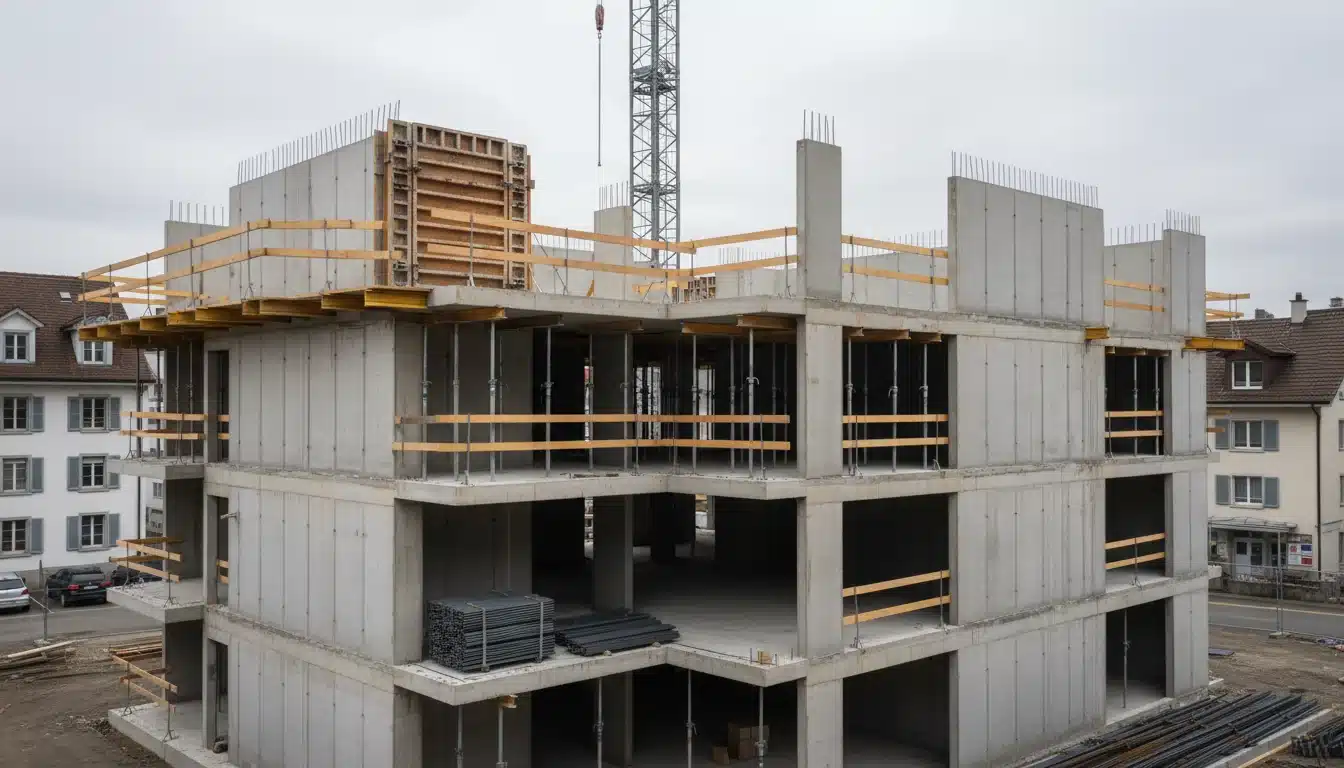
Structural work, what holds the building up
Structural work covers everything that ensures the strength and stability of a building. Earthworks, foundations, masonry, reinforced concrete, slabs, load-bearing walls, then the frame and the roof. Its goal fits in a builder’s phrase: make the building watertight and weathertight. Once the shell is closed and covered, rain and wind stay out, and the other trades can move in.
This is the heavy phase, the one that calls for cranes, concrete and curing times that cannot be rushed. In Geneva, structural work remains a pillar of local employment: the sector employs close to 6,000 people in the canton, carried by a little over a hundred firms. Across Switzerland, the main construction sector employs around 89,000 people. Nothing gets installed, neither partition nor cable, until this frame is up.
A construction company in Geneva carries its most visible responsibility on this phase, because a structural error cannot be undone at the finishing stage. It is also where a good share of future performance is set: the orientation of the volumes, the thermal mass of the materials, the thickness of the walls that will receive the insulation.
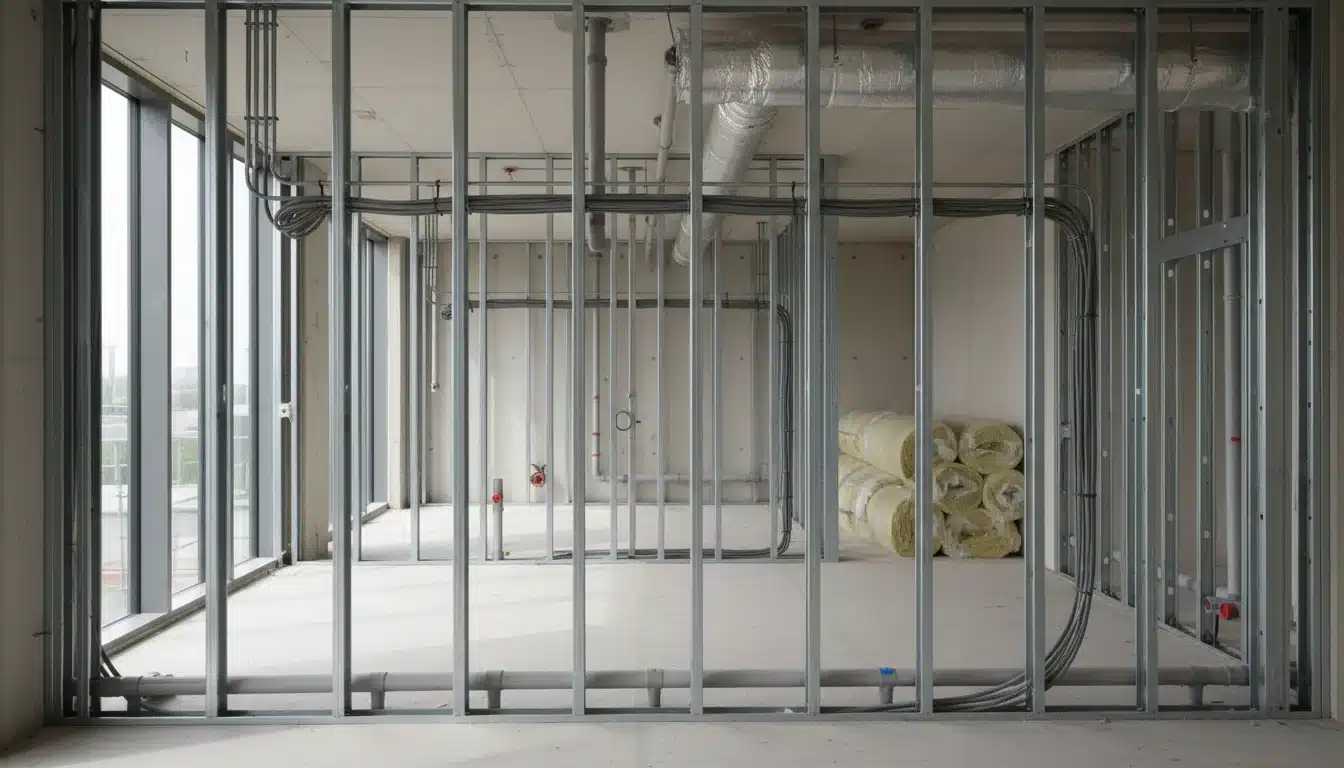
Fit-out, what makes the building livable
Once the building is closed and covered, the fit-out takes over. It brings together the majority of the trades and, most often, the largest share of working hours. This is where a raw volume becomes a place where people live and work. It reads in two families.
The technical trades
They move energy, water and information through the building. Electrical and lighting, plumbing and sanitary networks, heating, ventilation and air conditioning, automation and IT networks. These trades come early in the fit-out, because their conduits and pipes are embedded in the walls and slabs before everything is closed up. A conduit forgotten behind a finished partition, and it has to be reopened.
The finishing trades
They clad and insulate. Plastering, partitions, thermal and fire-stop insulation, screeds, floor and wall coverings, suspended ceilings, interior joinery, fitted furniture, painting. This is the register of comfort and energy performance. A sustainable construction largely plays out here, in the insulation of the envelope and the waterproofing, more than in the structure itself. The fit-out also carries everything the client judges by eye on handover day.

The order of the trades, the key to a jobsite that holds
A jobsite moves like a relay where each trade waits for the previous one. You do not pour a screed before the heating pipes are laid. You do not close a partition before the electrician has pulled the cables. You do not lay a parquet on a screed that is still damp. The sequence looks obvious written down, it is far less so on a real site where twenty firms each want their slot.
The friction point always sits at the interfaces, that moment when one trade hands over to the next. A tiler who runs three days late pushes back the joiner, who pushes back the painter, who pushes back handover. This is the whole point of coordinating the building trades: holding the schedule of hand-offs and settling agenda conflicts before they cost weeks. Knowing too who decides, who executes and who checks avoids much drifting, which brings us to the roles around a jobsite, from the client to the general contractor.
Why bring every trade under a single company
There are two ways to organize a jobsite. The first is to award each lot to a different firm and manage the twenty or so contracts, schedules and liabilities yourself. The second entrusts the whole to one company that carries every trade under a single contract.
The first model leaves the client alone at the interfaces. When a cracked tile reveals a screed defect, it falls to them to arbitrate between the tiler and the screeder, each blaming the other. The second model shifts that risk: one company answers for the result, holds the schedule and leaves a single point of contact. This is the principle of an all-trades contractor in Geneva, bringing masonry, technical works and finishes under one responsibility.
The gap widens further in renovation. Renovation works in an occupied building force the trades to be sequenced around the residents, water and electricity to be kept running, and shut-offs to be set within short windows announced in advance. No one holds that thread in place of a single project lead.
At Class Orga, we have practised this trade since 1981. A successful jobsite is not measured by the performance of any one trade taken alone, but by the cleanness of the hand-offs, from the first dig to the last coat of paint. That is the continuity we hold, project after project.