Space planning has established itself as a discipline in its own right within office fit-out. Born in the 1990s with the initial goal of packing more desks onto a floor, it has deeply transformed and is now a strategic tool serving productivity, well-being and employer brand. According to the latest JLL and Leesman studies, a well-run space planning project can reduce rented surface by 20 to 30% at constant headcount, while lifting employee satisfaction by 15% on average.
Improving the ergonomics of a workspace
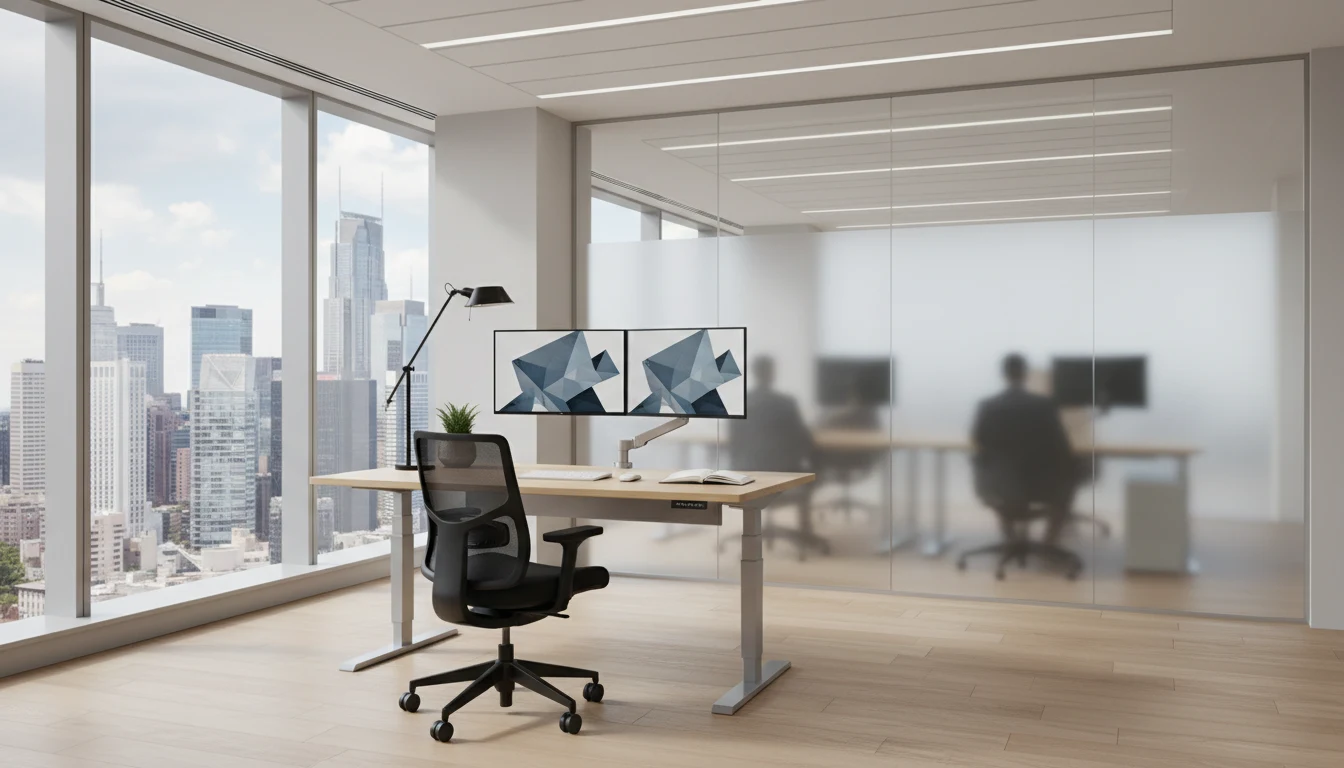
The initial goal of space planning was to fit as many desks as possible into a restricted area. The discipline quickly evolved toward raising productivity and, more recently, toward a holistic approach to well-being and flexibility. Today, space planning brings office fit-out into a broader thinking process where ergonomics, acoustics, natural light and hybrid ways of working come together.
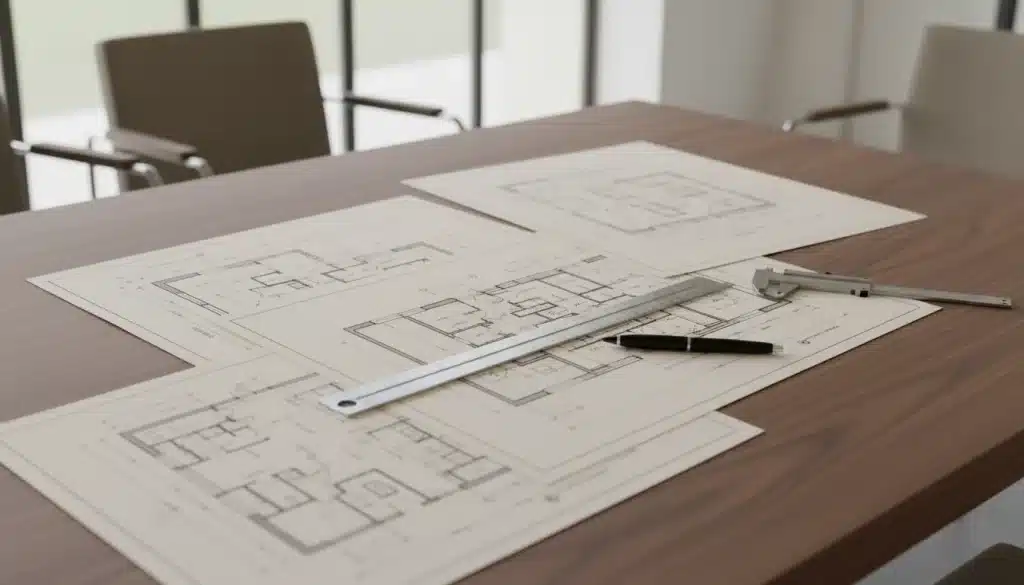
Designing a floor plan requires rigorous work: SIA standards, minimum distances between workstations (1.40 m face to face), lighting levels (500 lux on the work surface, 300 lux in circulation), acoustic absorption (αw ≥ 0.60 on ceilings in open-plan zones) and adherence to surface ratios. Nicknamed “the art of balance”, space planning unfolds in two key phases:
- Macro-zoning – a 2D or 3D analysis phase that splits the surface between collective zones (open-plan offices, coworking, meeting rooms, focus rooms, phone booths) and individual zones. Modern recommended ratio: 70% open spaces, 30% closed or semi-closed spaces.
- Micro-zoning – the fine-tuning phase of each workstation based on the employee’s needs: screen height, viewing distance (50-70 cm), choice of a sit-stand desk, orientation relative to windows to limit glare, dedicated storage. Indicative ratios: 4 to 6 m² per workstation on a bench, 6 to 10 m² in a generous open-plan office, 8 to 12 m² in a private office.
Supporting circulation and exchanges through space planning
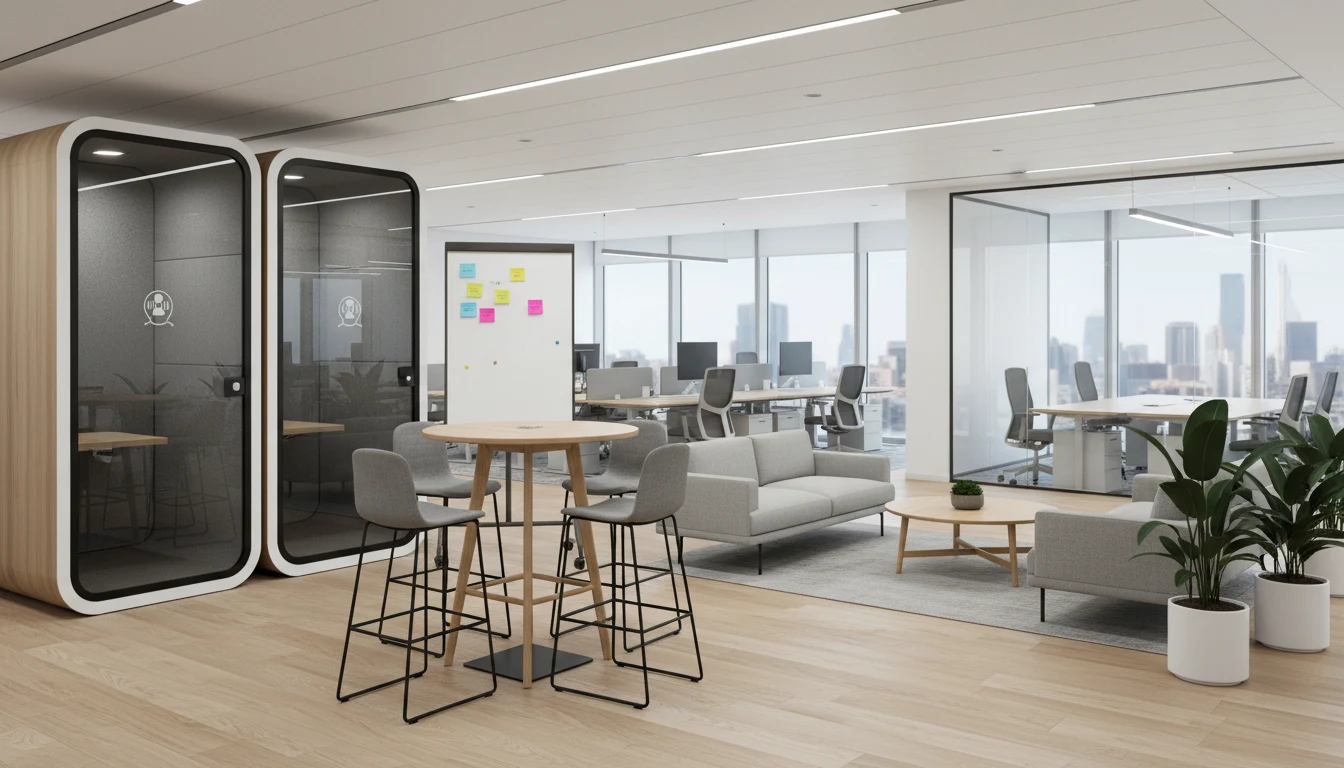
The Space Planner focuses on employee productivity and comfort. That is why they seek to create collaborative areas between employees and across the company’s teams. The goal is clear: open up the offices, bring teams closer and create connections without sacrificing focus.
In practice, a well-designed floor alternates between “volume” zones (open-plan, bench), “controlled-volume” zones (focus rooms, acoustic pods) and informal zones (lounge, standing-height tables, cafeteria). The 3-30-3 rule is gradually taking hold: a maximum of 3 steps to reach a collaborative workstation, 30 seconds to find a free seat, 3 minutes to reach a focus room.
This smart layout is far more complex than it appears. It also helps highlight a company’s values by promoting a pleasant place with a real team spirit. It is also a significant cost lever: by pooling spaces and adopting a sharing ratio of 0.7 workstations per employee (flex office model), it is possible to reduce the required surface by up to 25%, saving several tens of thousands of francs each year on a 30-workstation floor.
Why is space planning essential today?
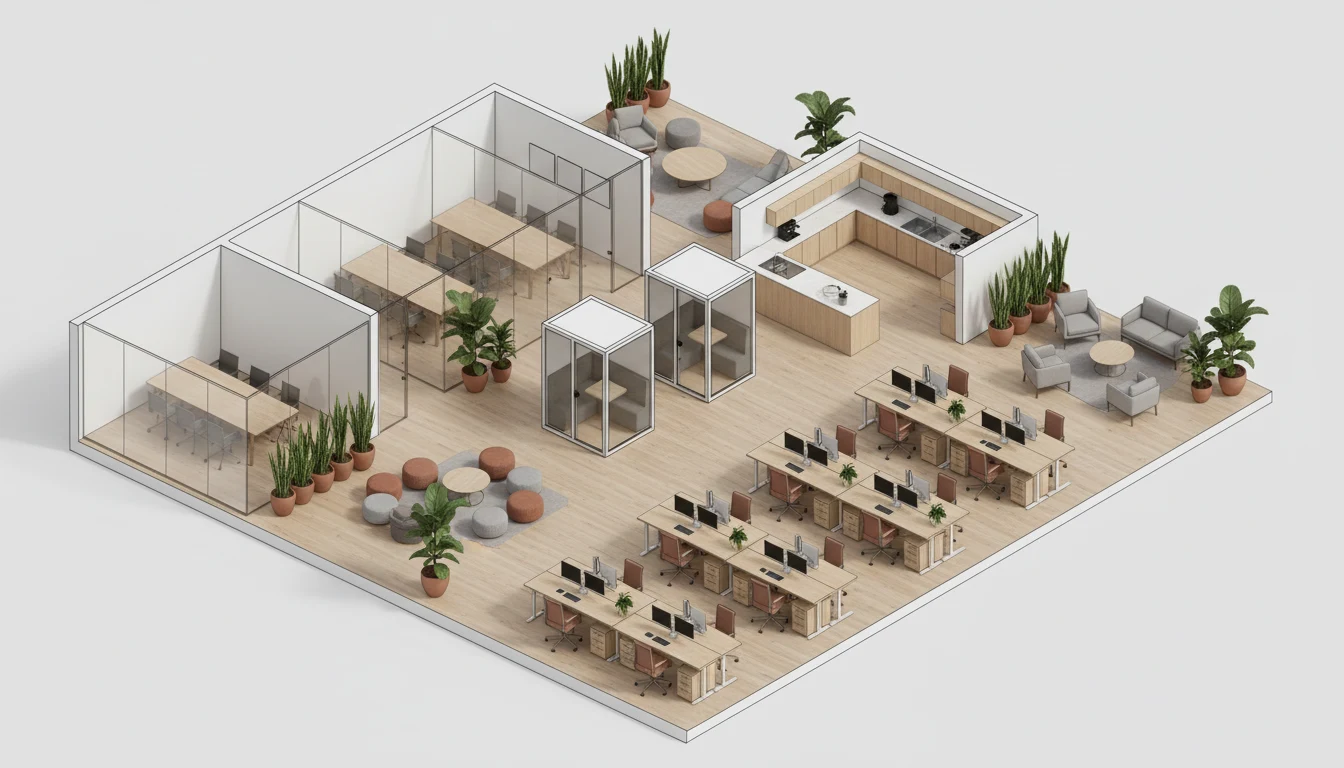
Unlike an architect or an interior decorator, the Space Planner focuses on safety rules and the building’s capacity (escape routes, fire compartmentation, structural loads). The ecological dimension also plays an important role: integration of LED lighting with presence detection, low-carbon materials, recyclable furniture, preservation of natural light through the orientation of circulation paths.
The Space Planner checks lighting, heating, air-conditioning and acoustics in every zone to optimise the employee experience. Every detail matters: ceiling height, the colour of finishes, residual noise level, air quality. The benefits of Space Planning are numerous for a company:
- Redefining the design to assert the company’s identity
- Lifting overall productivity (+12 to 20% according to studies)
- Supporting exchanges between teams and hybrid ways of working
- Integrating new technologies (room booking, occupancy sensors, video-conferencing)
- Allowing employees to embrace a shared project and strengthening the employer brand
- Optimising the rented surface and reducing property costs
The steps of a space planning engagement
A typical engagement unfolds in five steps, spread over 4 to 12 months depending on floor size:
- Assessment: site survey, analysis of ways of working through interviews and observation, measurement of real occupancy over two to four weeks.
- Programming: definition of needs by team, occupancy ratio, inventory of collective and individual zones.
- Macro-zoning and micro-zoning: 2D plans then 3D renderings, scenarios tested with the teams.
- Furniture and finishes: choice of ergonomic furniture, acoustic partitions, floor and wall coverings, wayfinding.
- Deployment: site works, installation, change-management support, post-move indicators (occupancy rate, satisfaction, absenteeism).
Indicators to track after a space planning project
A well-run project is a measured project. The main KPIs to track in the 6 to 12 months after delivery:
- Real occupancy rate of assigned or shared workstations (target: 70 to 85%).
- Meeting room and focus room usage (target: 60 to 80%).
- Employee satisfaction score through an internal survey (workspace NPS).
- Sound level in open zones (target: ≤ 55 dB during the day).
- Evolution of absenteeism and turnover at 12 months.
Reorganising a workspace is a major change within a company. That is why rigour is required at every stage of the design. It is therefore advisable to adopt a professional approach, drawing on the lessons of space planning. Contact Class Orga for an assessment of your current spaces and an action plan suited to your organisation.